Putting the Fire in the Equations; Generating multilevel dynamical processes in
Physics and Psychology
Physics Articles
/ Talks /
Bibliography |
Psychology Articles /
Talks /
Bibliography |
Search
|
Physics Articles
/ Talks /
Bibliography |
Psychology Articles /
Talks /
Bibliography |
Search |
|
|


Next: 10.4 Measuring as Actualising Up: 10. Quantum Substances Previous: 10.2 Probabilities and Propensities Subsections
10.3 Waves, Particles and ComplementarityOne feature of the present account of substances is that they are not necessarily located in small volumes of space, as, for example, the corpuscles or `particles' of classical physics would be. The propensity fields that have been defined do not even have any special `centre' distinguishable from all the other places in the field. They have no centre which could be regarded as the `true substance', so that the surrounding field could be regarded as just the `sphere of influence' of the central substance. This was Boscovich's conception, and it slowly percolated into physics, resulting in the `dynamic matter' of the mid-nineteenth century. This view is best summarised by the aphorism ``No matter without force, no force without matter''. Our propensity fields, though, have no special continuing centre: the only `point source' which could perhaps be identified is the source event, which must have a definite location in space and time. The field is therefore only localised very briefly, if at all, at times just after this source event. The `continuants' we define are thus occasionally, but never necessarily, strongly localised. For most of the time they have significant spatial extensions. Various reconsiderations to ideas of particles have been suggested by quantum physics have over the last sixty years, but for the most part come fitfully and in scattered parts of which few physicists or philosophers were fully aware in a critical sense.
|
 |
 |
(10.1) | |
 |
 |
(10.2) | |
 |
 |
(10.3) |
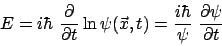
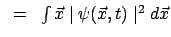
 for the whole
quantum substance are only defined in this mean or
secondary sense, by averaging local logarithmic derivatives
over the extent of the propensity fields.
for the whole
quantum substance are only defined in this mean or
secondary sense, by averaging local logarithmic derivatives
over the extent of the propensity fields.
The conjunction of an extensive field with some actualising event also corresponds, I believe, to what Niels Bohr has called10.7 the basic `quantum phenomenon', being an `undivided' and `closed' occurrence. It is `undivided' because between the source and realising events is a single extensive propensity field, and not any intervening actual events which could constitute some kind of unknown connection. It is `closed' because once a place in a propensity field has become realised, the field no longer exists: its history is closed. Bohr's `complementarity' of the wave and particle aspects of the quantum phenomenom arises because although a propensity field can be regarded as propagating through space and time like an oscillating wave and as obeying a wave equation, it is in fact a single field which can produce only one actual event. This event must be at one definite place, just as a strongly-localised particle would produce. If we were not aware of the notion of a `distribution of propensity for a definite event', we would be confused because sometimes the continuant behaves like a wave, and sometimes like a particle.
This quantum substances are capable of acting like a wave, and capable of acting like a particle, as Bohr's complementarity asserts. Once it is determined, however, what events actually occur, then, at each time, a quantum substance is quite definitely either a wave or a particle. At any given time, it is either a field (with wave-like patterns), or undergoing a localisation event (with a sort of particle-like localisation). It in fact never behaves like a traditional `corpuscle', in that it never has a localised extension which is constant for any finite (non-zero) duration. This is because the localising events (as the production of purely actual past-events) have no finite and divisible duration.
Consider the two-slit intereference experiment with beams of electrons. The emission of electrons produces a field of propensity that extends through space (in the direction of the beam) and endures through time. The exact form of this distribution will be governed by something like Schrödinger's time-dependent equation. It will have wave-like characteristics according to the variation of momentum (see above) in different parts of the field. As in Maxwell [1988, p. 16], when the electron field overlaps with the field of the two-slitted screen, either the electron is absorbed by the screen and there is an actual event (an instantaneous, probabilistic collapse of the wave packet), or the electron wave packet passes through both slits towards the photographic film. In that case, the electron field extends across in the intervening space, and the parts of the field that came through different slits will interfere with each other constructively or destructively in a wave-like manner. Eventually the recombined electron-field will overlap with the photographic plate, more specifically with all the photographic grains in the plate. An actual event can necessarily occur on interaction with only one of these grains: this amounts to a reduction of the wave packet to a highly localised form trapped in the grain. Thus, one particular grain is definitely exposed, and none of the other grains will be exposed. If the whole process is repeated with many electrons over a period of time, then a statistical distribution of exposed grains will be built up according to the probabilities resulting from the propensity distribution of the recombined electron-field.
The exact sufficient condition for an actualising event will be discussed in chapter 12; Maxwell proposes that is the difference in energy between the exposed and unexposed grains which triggers the actual localisation of the propensity fields.
Superpositions and Mixtures
Until an actualising event occurs, the propensity fields may well extend
over a wide range of possibilities. In the language of quantum mechanics,
we would say that the quantum system is in a superposition of these
different possibilities. After an actualising event occurs, then only one
possibility can be realised for each propensity field (each quantum
substance), and there will be different probabilities for the different
outcomes. What this corresponds to in the language of quantum mechanics
depends on whether we know what the actual outcome is. If we do know, then
a measurement is said to occur.
If we do not know the particular result, but only that some
definite outcome did obtain, then the system is said to be in a
statistical mixture of the different possibilities. The
statistics arise here because of our ignorance as to what actually
happened.
It would appear in summary, then, that the present conception of substance is able at least qualitatively to account for several of the features of nature that have been captured by quantum physics, and which are mysterious or impossible in classical physics. We can see how there might arise a `wave-particle complementarity', indeterminacies, objective probabilities, diffraction, interference and tunnelling effects.
|
|